2026-03-26
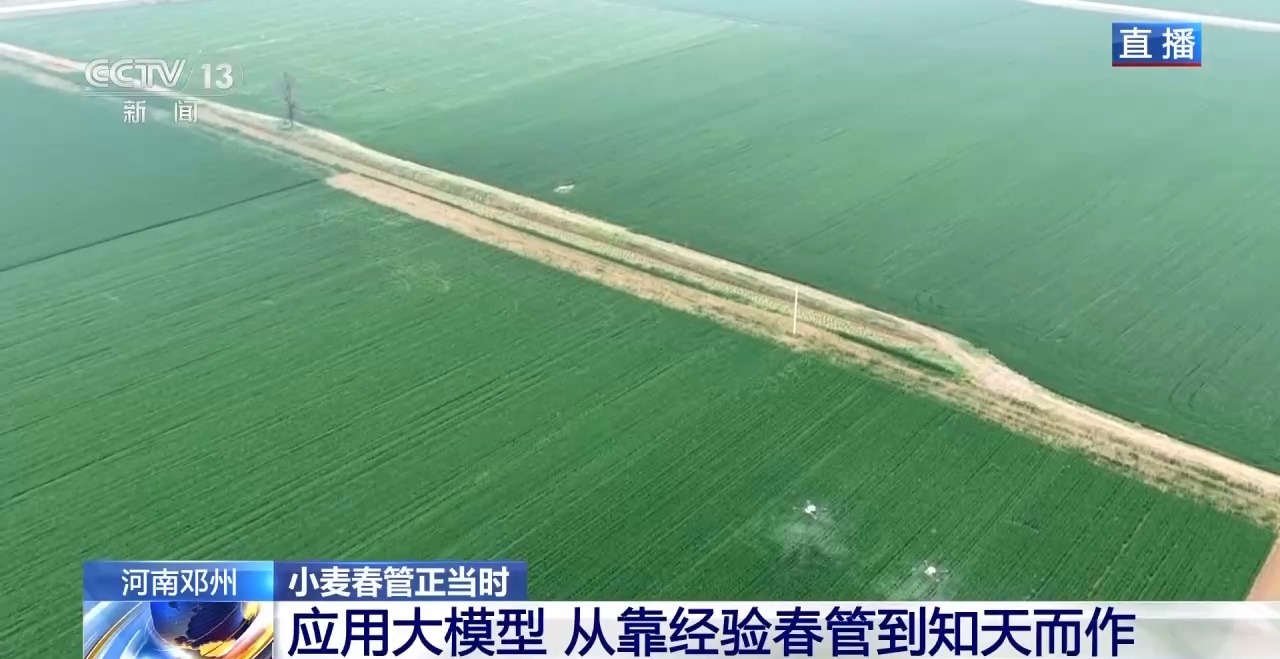
26Henan is China's main summer grain production area. After the Spring Equinox, temperatures keep rising and wheat growth is accelerating, entering the critical period of spring field management. How is the wheat doing there?
"Spring competes by the day, summer by the hour." Over the next five days daytime highs in Henan will stay above 20°C, and wheat moves from regreening into the jointing stage. Wheat grows fast at jointing, and this is a key period requiring plenty of water and fertilizer. Recent widespread rain has left soil moisture in good condition, so no irrigation is needed. Drones are flying plant-protection missions, mainly against pests and diseases: stripe rust and fusarium head blight on the disease side, aphids and red spider mites on the insect side.

There are two months until the summer grain harvest. How is the wheat doing? After a series of earlier measures to strengthen weak seedlings, the latest crop survey shows Class 1 and 2 seedlings account for 89.5% - nearly 90% - far better than expected.

How do you judge whether wheat is growing well?
Visually, wheat at jointing should have thick, dark-green leaves - that is good. Weak seedlings are tender green, and malnourished ones even show yellow leaves.
The stems should be firm, elastic and tough, able to support the lush leaves and the weight of the future ears.
Look at the roots: more secondary roots with a milky white color is good. Poor seedlings turn black or yellow, and if infected with crown rot or sharp eyespot, there will be rot.

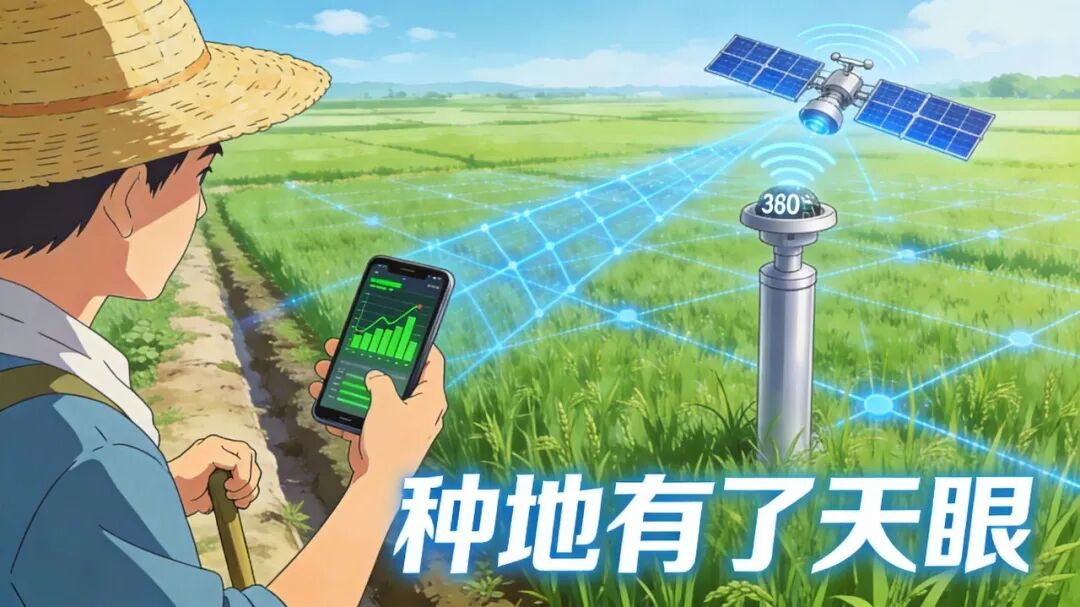
Field management in the coming two months is also crucial. With technology, the wheat fields have achieved smart spring management. The locality worked with Nanjing Agricultural University to develop the "Huigengyun" agricultural big data model. Through a "space-air-ground" integrated monitoring network it collects data, updating every five minutes and sending it to the backend platform. This is not a simple application of "general AI" - it is an AI model that has learned the local soil, seed and climate characteristics. Farmers can ask the model about any aspect of wheat growth at any time.
Farming used to rely on experience and the guidance of agronomists; now agricultural foundation models can provide precise services. On this land, agricultural technology has turned "depending on the weather" into "farming with the weather".
Entering the key period of wheat water and fertilizer management - technology makes field management more efficient
At present, the 721,000 mu of wheat in Wuzhi County, Jiaozuo, Henan, are entering jointing - the critical stage for water and fertilizer management. IoT, big data, multispectral drones and other technologies are widely used here, making wheat field management more efficient.
At the wheat base in the Yellow River floodplain of Dafeng Town, Wuzhi County, green seedlings are growing well. Plant-protection drones with Beidou navigation are efficiently carrying out pest control. Drip tapes laid across the fields act like "nutrient pipelines", delivering water and nutrients precisely to the wheat roots. Paired with a smart water-fertilizer integration irrigation system, farmers can start irrigation and fertilization with a tap on the phone.

Grain grower Zhang Bing-yun:"No need to go to the field to open and close valves any more - I can easily manage more than 3,000 mu. With this equipment, fertilizer use efficiency can reach 60%, and irrigation water can be cut by 40%."

CCTV reporter Li Enhao:The newly deployed multispectral drone hive receives patrol tasks via computer commands, achieving automatic takeoff and landing and automatic data return. Its efficiency is 120% higher than traditional manual collection.

Wei Xiang, technician at the Yellow River floodplain wheat base:After it finishes its mission and returns to the hive, the data is packaged and uploaded to the cloud platform, which analyzes all the route data from that mission and the images taken at each waypoint into a plant growth map.

At the agri-service center near the base, a large seedling monitoring screen displays soil moisture, temperature and pest data in real time. Relying on the "smart agriculture" platform, the locality integrates satellite remote sensing, soil sensors and field IoT devices into a "space-air-ground" integrated seedling monitoring system.

Gu Jing-li, technical lead of the agricultural informatization platform at the Yellow River floodplain wheat base::"Through information integration, we can monitor soil moisture, temperature and wheat growth; after big-data analysis we precisely classify weak-seedling and strong-seedling fields, matching spring management measures precisely."